
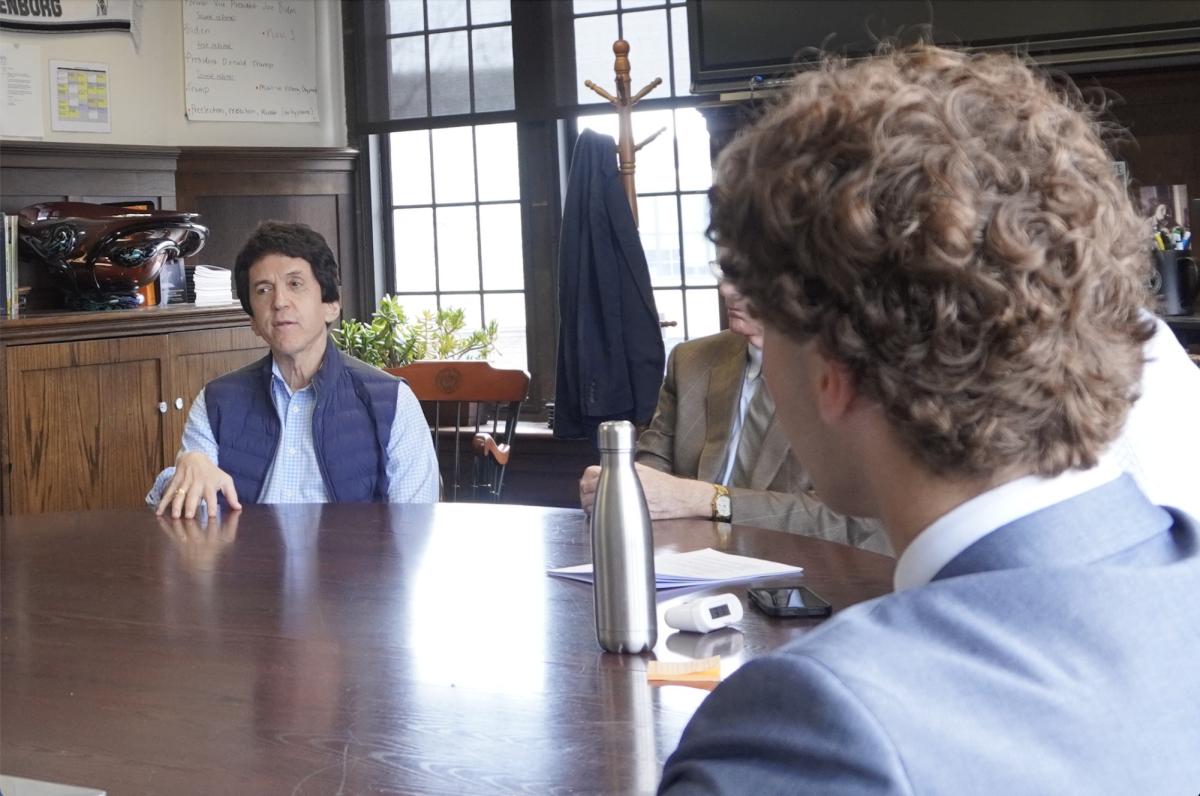















Lou Jeffries does not consider himself an important person at The Hill School.
“If I leave here tomorrow, I don’t think it would affect the school in any way at all,” he said.
He was speaking inside the Hill archives on the top floor of the Ryan Library. The archives was originally built on the second floor during the 1990 renovation of the library; however, with the rise of the digital age, numerous school leadership changes led to the archives being dismantled and moved to the basement. The second floor was subsequently repurposed as a server room. In the 2010s, Jeffries, with the assistance of Dr. Henry Bender and Mary Selan— both of whom have since left the school—relocated the archival materials to the top floor of the library, where they established the current archive room.
Caked in dust on the shelves near the entrance are leather-bound volumes and yellowed parchments that, in a way, sketch out 175 years of Hill history. The right shelf holds issues of The Hill News from 1903 to 1994 on the top shelves and The Record on the bottom, while the left houses the Hill School Bulletin from 1921 to 1994. In the narrow space behind the door sits Jeffries’ desk, along with a partial collection of The Dial stored in glass display cabinets. A round table stretches across the center of the room, strewn with folders, photographs, and unopened letters. Here, Lou Jeffries sits and types into his computer.
“What you can do is, you can put in a keyword, like co-education, or whatever, and it would come up with articles in different issues of The Hill News,” he said. He was referring to The Hill School Digital Archives, a project he has been working on since becoming head of archives.
Jeffries first came to Hill in 1999 as the director of library. In 2016, then-head of school Zachary G. Lehman asked him to take over the archives as the school’s first official archivist. Jeffries’ primary objective has been to preserve and modernize the Hill archives, which has involved organizing the contents of the archives and, more importantly, digitizing The Hill News and The Hill School Bulletin—an alumni journal now known as Hill Ties—for better accessibility. To date, issues of both publications up to the year 2020 have been digitized.
Depending on the circumstances, the issues often require different methods of digitization. Most issues of The Hill News had copies on microfilm and were sent to a company called Smedia for digitization. “It’s in Australia, of all places. I practically kissed it goodbye,” Jeffries said, with a wry smile.
Along the far end of the room ran a long bank of cabinets containing artifacts, textiles, and photographs. Cabinets on the right had drawers labeled with the names of past heads of school and notable alumni. Cardboard boxes, filled with more volumes of The Hill News beginning in 1994, were stacked to the ceiling.
Those particular issues were sent to Docutek in Englewood, Colorado, via Federal Express, for digitization. As Docutek takes the copies apart during this process, Jeffries never sends anything unless he has already ensured an additional copy is safely stored in the archives.
He added, “And if something happened—the airplane it was on crashed or something—I know it’s far-fetched, but that’s why I always keep a copy here.”
Chris Chirieleison, Athey Family Master Teacher of History and Social Sciences, worked with Jeffries on the compilation of major events in Hill history for an H-term history course in 2020. He stressed the significance of Jeffries’ work. “I always bring my students up to the archives, at the end of the year, to have Mr. Jeffries share with them about his work, and the value of the archives.”
Chirieleison also requested access to the digital archive, which he has used on numerous occasions to work on research for projects. “His initiative there, in undertaking such an immense project of digitizing The Hill News, is just so beneficial to those of us who care about that history,” said Chirieleison.
Jeffries has temporarily paused the digitization of the archive materials in preparation for the school’s upcoming 175th anniversary. He expects to resume the project in the spring, he said.
As the archivist, Jeffries is well known for his encyclopedic knowledge of the history of Hill. He has authored numerous articles on critical narratives such as co-education, the segregation of African Americans, the influx of international students, and history of computers and technology at Hill.
“He epitomizes knowledge of the school,” said Ari Baum, associate head of school. “And it’s, like, his life. He doesn’t do it as a job. He does it as a life. He takes this historical school and makes it come alive every day, in every conversation, in every step he takes on campus.”
When reflecting on the many historical milestones that shifted the school’s trajectory, Jeffries was quick to point to the school’s decision to turn co-educational.
He said, “If you go to the CFTA, down the stairwell, you would see three sets of boards. They have the students with the highest grade point average, students who are co-presidents of the student government association, students who won the headmaster award. Half of them were women the second year the school turned co-ed.”
Although Jeffries himself was never a student here, his late brother graduated from Hill in 1956, and his brother’s son—his nephew—graduated in 1990.
“I was at [my nephew’s] graduation in May of 1990. And I never thought I would come back in nine years to work here. That thought never crossed my mind,” said Jeffries.
Most days, Jeffries goes to breakfast at 7:30 and dinner at 5:30. Many come to know him at the dining hall; he is a fixture at the “breakfast club”—the group of faculty who routinely attend breakfast in the dining room. “It’s always interesting talking with Mr. Jeffries over a cup of coffee,” said Cathy Skitko, director of Hobart’s Run Communications and Community Partnerships.
To those who know Jeffries well, it is evident that his knowledge and passion extend far beyond the archives. “Students might be surprised to learn that Mr. Jeffries is a major movie buff,” Dr. Matthew Rinkevich, chair of the department of religious studies and philosophy, said. “He loves film and the history of film, and he makes a point to try and see each year’s Best Picture Oscar nominees. Mr. Jeffries ‘dream course’ to teach at The Hill would probably be one on the history of cinema.”
Indeed, the CFTA is Jeffries’ second-favorite place on campus. “He has been a big, behind-the-scenes supporter of the arts at Hill. I believe he attends every—or almost every—concert, play, and recital at The Hill,” Skitko said.
Jeffries is known to jump into school events with enthusiasm and frequently enjoys the spring Classics trips to Italy. For Baum—who also serves as the head varsity girls’ ice hockey coach—a particularly fond memory was when Jeffries accompanied the team to Hotchkiss; there, he educated both teams on the long-standing rivalry between Hotchkiss and Hill.
Baum said, “Him getting on a bus, going five hours to Hotchkiss, teaching the two teams on the history of their rivalry, watching the game, then coming right back on the bus, five hours again, all in one day… Just really, really legit.”
Despite all evidence to the contrary, Jeffries often self-deprecatingly claims he does not have charisma.
Skitko disagrees. “He does,” she insists, pointing to the dictionary definition: “compelling attractiveness or charm that can inspire devotion in others.”
“Mr. Jeffries should know that many people at Hill, from students and staff to faculty, admire and care about him deeply, not only for his ‘divine’ talent of knowledge and his remarkable memory, but, far more importantly, for his authentic concern for others, integrity, and selflessness.”